Ask five people in Oklahoma what a barndominium is and you'll get five answers. One is describing a steel building with an apartment in the corner. Another means a shop with a house attached. A third is picturing something they saw on television that was, strictly speaking, a converted barn.
The words matter more than they look like they do, because barndominium, shouse, pole barn home, and post-frame home describe genuinely different buildings, built different ways, at different prices, financed and insured differently. Getting the vocabulary straight is the cheapest thing you can do before you start collecting quotes.
We've been building custom homes in Oklahoma since 1964. Here's what each term means and which one describes the building in your head.
Barndominium
A barndominium is a residential home built on a metal or post-frame structure, usually combining living space with a garage, shop, or workshop under one roof. The name is a portmanteau of barn and condominium, which is a slightly odd fit, since almost none of them are condominiums and most were never barns.
In practice, when someone in Oklahoma says barndominium, they mean a house whose structure is a metal building and which probably has a shop attached. That's the working definition, and it's the one we use.
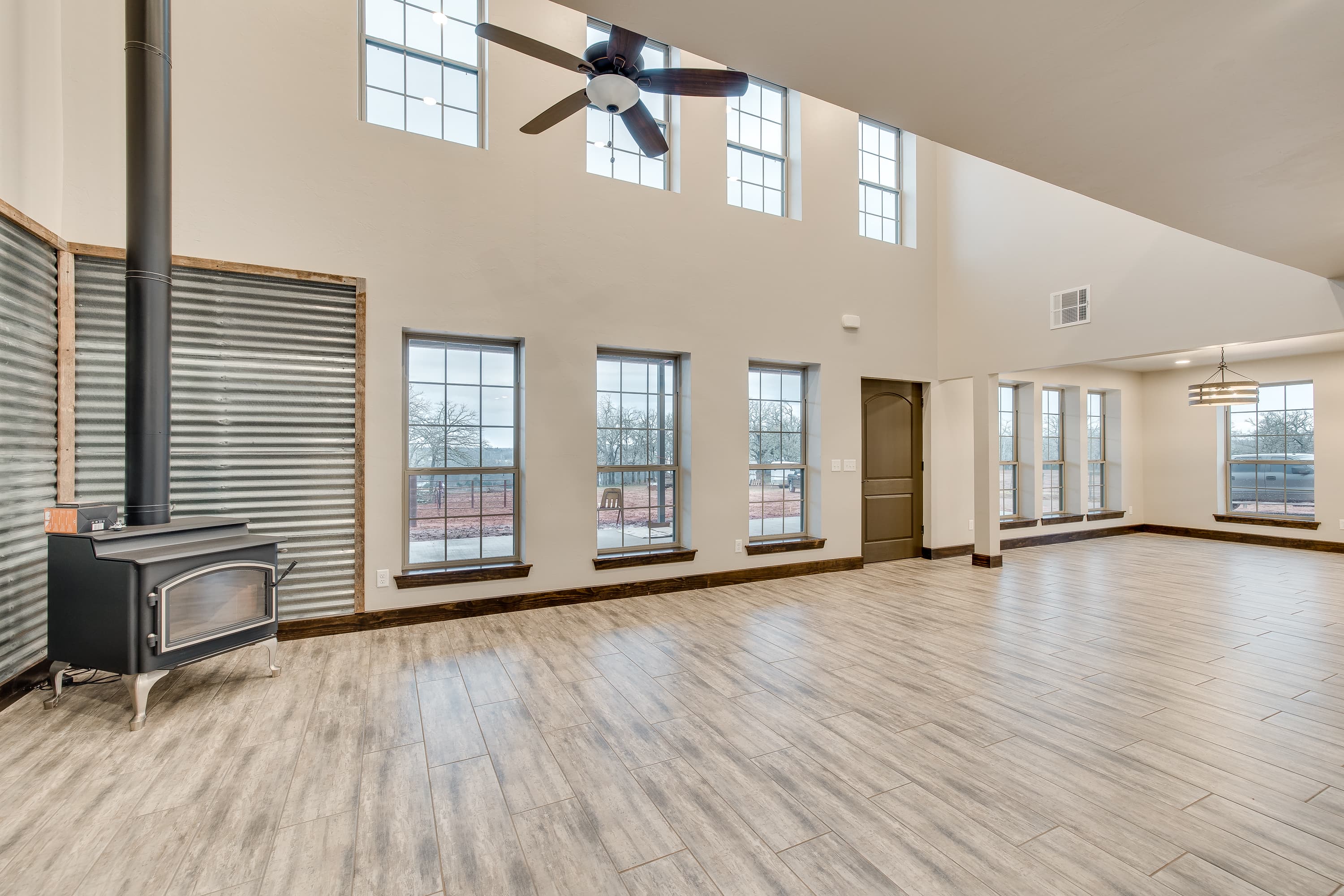
The appeal is practical: long clear spans with no interior load-bearing walls, high ceilings, low-maintenance exteriors, and the ability to put the house and the shop in one building instead of two. On rural acreage, where you're already paying to bring utilities to one spot, that consolidation is worth real money.
Shouse
Shouse is shop plus house, and it describes the same category of building with the emphasis reversed. A barndominium is a house that happens to have a shop. A shouse is a shop that happens to have living quarters.
The distinction is one of proportion, not construction. Both are typically post-frame or steel. But it matters for two practical reasons. First, a building that's mostly shop finishes at a much lower cost per square foot, so a blended per-square-foot number means very little. Second, appraisers and insurers look at the ratio of living space to shop space, and a building that reads as mostly-shop can get classified as an agricultural or commercial structure rather than a residence. That affects both your loan and your policy.
If you're planning something shop-heavy, say so early to your lender and your insurer. We cover the loan side in financing a barndominium in Oklahoma.
Pole barn home and post-frame home
These two mean the same thing, and it's a construction method rather than a style.
Post-frame building uses large laminated columns set into or onto the ground at wide intervals, carrying the roof loads directly. There's no continuous foundation wall in the traditional sense, and the wide post spacing is what produces those big open interiors. Pole barn is the older, more colloquial name for the same system.
Post-frame is generally less expensive to erect than red-iron steel and is extremely common on Oklahoma acreage. It's a perfectly good way to build a house when it's detailed as a house. The catch is exactly that: a post-frame structure detailed like a barn and then finished out as a home is where moisture and insulation problems come from.
Steel frame and red iron
Red iron refers to structural steel framing, named for the oxide primer that gives it its color. It's the system used for most commercial metal buildings and for the larger, longer-span barndominiums.
Steel costs more than post-frame up front and buys you longer clear spans and a very strong structure. For most residential barndominiums in Oklahoma, either system works, and the choice usually comes down to span requirements and price at the time you build.
Metal building home, and what it doesn't tell you
Metal building home is the broadest term of the lot and describes the exterior rather than the structure. A house can have metal siding and roofing over conventional wood framing, which makes it a stick-built house that looks like a barndominium.
That's worth knowing because it's a real option. If you want the look but the site or the plan suits conventional framing, you can have it. It just isn't a barndominium, and pricing it as one will mislead you.
So which one are you describing?
| If you want | The term is | Structure |
| House with attached shop | Barndominium | Steel or post-frame |
| Shop with living quarters | Shouse | Steel or post-frame |
| Big open spans, lower cost | Post-frame / pole barn home | Laminated columns |
| Longest spans, heaviest frame | Red iron / steel frame | Structural steel |
| The look, conventional build | Metal building home | Wood framing, metal skin |
| Shop, barn, storage only | Post-frame building | Kit and erector is fine |
Why you rarely find a barndominium for sale in Oklahoma
People search for barndominiums for sale in Oklahoma City and around the state, and they don't find much. There's a reason, and it isn't scarcity of interest.
These homes get built by the families who intend to live in them, on land those families already own, to a plan built around a specific shop, a specific hobby, or a specific number of horses. They're personal buildings. They don't turn over often, and when they do, the shop that made it perfect for the first owner is frequently wrong for the second.
Which means for most people the practical route isn't shopping for one. It's building one, usually on land you already have or are about to buy. If that's where you've landed, our guide to what your land needs before a barndominium can go on it is the right next step.
Where to go from here
Once you know which building you're describing, the next three questions are what it costs, what it looks like inside, and whether your land will take it.
- What a barndominium costs to build in Oklahoma — the pricing picture, from kit shells to finished homes.
- Barndominium floor plans in Oklahoma — the layouts that work inside a rectangle, by size.
- What your land needs first — septic, water, electric, zoning, and site prep.
- Choosing a barndominium builder — for when you're ready to talk to companies.
If you're earlier than all of that and just curious how these buildings go together, how barndominiums are built walks through the process from slab to finish.
Questions people ask us about the terminology
Is a barndominium the same as a pole barn?
Not quite. Pole barn describes the structural system. Barndominium describes what the finished building is used for. A barndominium can be post-frame, or it can be steel.
Is a shouse cheaper than a barndominium?
Usually, per square foot, because more of the floor area is unfinished shop. The living portion costs about the same either way.
Are barndominiums considered real houses by lenders?
Yes, when they're built as primary residences by a custom home builder. Where lenders get cautious is with kits, owner-builds, and buildings that read as mostly shop.
Do barndominiums hold their value in Oklahoma?
Ones finished to normal residential standards generally do. Ones finished like a shop with a bedroom in it are harder to sell and harder to appraise.
Can you build one inside city limits?
Sometimes. Zoning varies considerably across Oklahoma, and some municipalities restrict metal exteriors in residential districts. It's a question to answer before buying a lot.
Not sure which one you want?
Tell us what you're picturing and where the land is, and we'll tell you which building you're actually describing and roughly what it costs. Sometimes people discover they wanted a conventional house with a metal roof, and we'll say so. No pressure and no pitch. Get in touch here.
Ready to Build Your Custom Home?
Turner & Son Homes builds on your land with a fixed-price guarantee. Let's talk about your dream home.